.png)
Pakistan Police Character Certificate from Canada: Complete Guide
To get a Pakistan Police Character Certificate from Canada, you usually authorize a trusted representative in Pakistan to apply at the district police office where you last lived, or you use a provincial online portal if your province supports it. In Canada, your main job is to prepare notarized identity documents, an authority letter, photos, address proof, and fingerprints if the police department asks for them.
A Pakistan Police Character Certificate from Canada is often needed for immigration, visas, employment, and background screening. The exact process depends on your last Pakistani address, the province, and the purpose of the certificate.
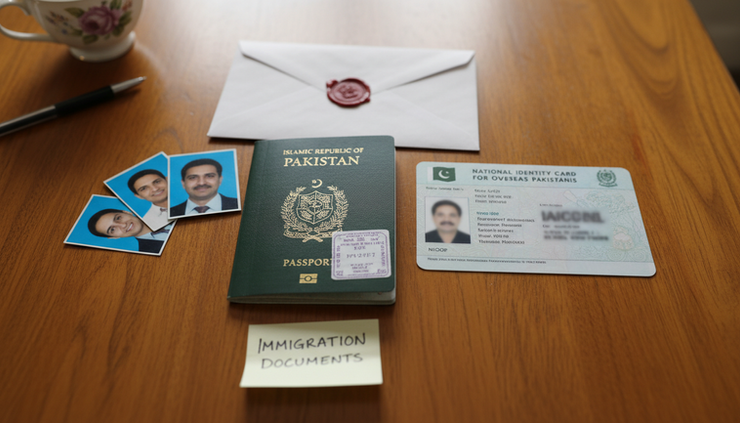
What it is and who needs it
A Pakistan Police Character Certificate is an official police record check issued in Pakistan. It confirms whether the police have any criminal record information connected to the applicant in the district or area covered by the issuing authority.
People commonly need it for:
Canadian immigration through IRCC IRCC may ask for a police certificate if you lived in Pakistan for six months or more after turning 18. This can apply to permanent residence, some temporary residence files, sponsorship cases, and other immigration applications.
Gulf country visas Countries such as the UAE, Saudi Arabia, Qatar, Oman, and Kuwait may ask for a police character certificate for work, residence, or family visa purposes.
UK visas and immigration files Some UK visa categories, especially work or long-term stay applications, may require police clearance from countries where the applicant lived.
Employment screening Employers may ask for it when hiring for roles that require a background check, especially in education, health care, security, finance, government-related work, or regulated industries.
The certificate is normally tied to where you lived in Pakistan. If you lived in more than one district, the receiving authority may still ask for a certificate from your most recent district, but some cases require more than one certificate. Always check the instructions from IRCC, the visa office, the employer, or the consulate before applying.
Who issues it
Pakistan Police Character Certificates are issued by the police authority in Pakistan, usually through the district police office where you last lived. The process is not handled by Canadian police, Canadian notaries, or IRCC.
The issuing path usually falls into one of these categories.
District police where you last lived
Most applications are handled at the district level. Your representative in Pakistan may need to visit the police facilitation centre, district police office, or relevant branch responsible for character certificates.
The district may verify:
Your identity
Your Pakistani address
Your period of residence
Local police station records
Any required supporting documents
Requirements can vary from Lahore to Karachi, Islamabad to Rawalpindi, or smaller districts. One district may accept a simple authority letter and copies, while another may ask for extra forms, fingerprints, or original documents from your representative.
Provincial online portals
Some provinces offer online or semi-online systems. Punjab and Sindh have introduced online services or facilitation systems for police character certificates in many areas.
These portals can make the process easier, especially if:
Your district is covered
You have valid Pakistani identity documents
Your address details match the records
You can arrange any required verification in Pakistan
Even with an online portal, an overseas applicant may still need a representative for follow-up, pickup, courier, or local verification.
Paper application through a representative
For many applicants in Canada, the practical route is still a paper application through a trusted representative in Pakistan. This representative may be a family member, friend, or lawyer.
They usually submit your authority letter and supporting documents, deal with the district police office, pay the local fee, collect the certificate, and arrange courier back to Canada if needed.
Choose the representative carefully. They will handle sensitive personal documents, and delays often happen when the representative submits incomplete forms or applies in the wrong district.
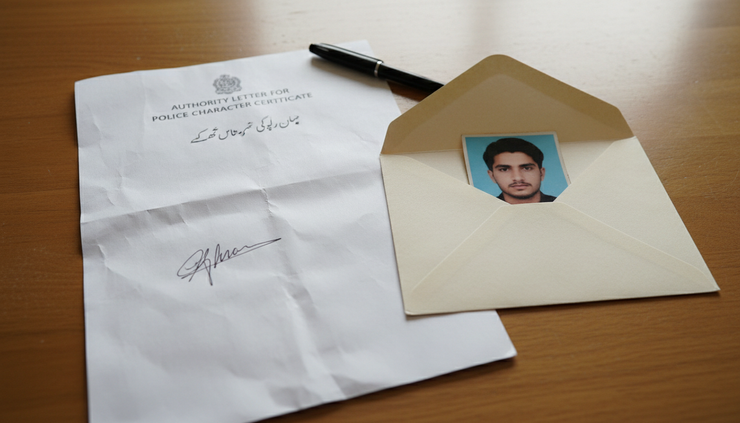
What you need
The exact document list can change by district, but most applicants should prepare the following.
Notarized authority letter This letter gives your representative permission to submit and collect the police character certificate on your behalf. It should include your full name, passport number, NICOP or CNIC number, Pakistani address, representative’s full name, and their identity details.
Passport copy Include the photo page and any pages that show Pakistani entry or exit stamps if relevant.
NICOP or CNIC copy A valid NICOP or CNIC is usually required. If your NICOP is expired, renew it before starting whenever possible.
Proof of Pakistani address This may include an old utility bill, tenancy document, family registration details, copy of a Pakistani identity card showing the address, or other proof accepted by the district police.
Passport-size photos Requirements vary, but it is sensible to prepare recent photos with a plain background.
Local fee The fee is paid in Pakistan. It may vary by province, district, urgency, or delivery method.
Fingerprints, if asked Some districts or receiving authorities may request fingerprints. If fingerprints are required, use a proper ink fingerprint card or digital-to-card service from a trusted provider.
Representative’s ID copy Your representative may need to show their own CNIC and contact details.
In Canada, the authority letter and document copies should usually be notarized or certified before sending them to Pakistan. If you need help preparing those documents, use reliable notary public services so the authority letter and copies are clear, properly signed, and suitable for overseas use.
If fingerprints are requested, applicants in Alberta can arrange RCMP-accredited fingerprinting in Edmonton and ask whether a physical fingerprint card can be prepared for overseas submission.
MFA attestation and apostille
For many uses abroad, the police character certificate may need extra authentication after it is issued in Pakistan. This can include attestation by Pakistan’s Ministry of Foreign Affairs, often called MFA attestation, and in some cases an apostille.
Pakistan began using apostille services after joining the Hague Apostille framework in 2023. An apostille is meant to make a public document easier to use in another member country. It confirms the authenticity of the signature or seal on the document, not the truth of the document’s contents.
The right path depends on where the certificate will be used.
For example:
A Gulf employer may ask for MFA attestation, embassy attestation, or both.
A UK-related file may ask for an apostille, depending on the document type and receiving authority.
IRCC may focus on the police certificate itself, plus a certified translation if the document is not fully in English or French.
Employers may set their own rules, especially when HR or licensing bodies are involved.
Do not assume one form of authentication works for every purpose. Before you spend time and money, confirm the receiving authority’s instructions in writing if possible.
MFA attestation and apostille do not replace the police certificate. They are extra steps that may be required after the certificate is issued.
Certified Urdu-to-English translation
Many Pakistan Police Character Certificates include Urdu, English, or a mix of both. Some are mostly English, while others contain Urdu stamps, handwritten notes, officer details, or local-language content.
For IRCC, employers, universities, licensing bodies, or foreign visa offices, a certified translation may be needed if any part of the document is not in English or French.
A proper certified translation should usually include:
A complete translation of all visible text
Translator certification
Translator contact information
A copy of the source document attached or referenced
Clear formatting so the officer can match the translation to the original
Avoid translating only the “main” part of the certificate while ignoring stamps, seals, handwritten notes, or officer titles. Those details often matter.
If your certificate comes back in Urdu or partly in Urdu, use certified translation services so the final package is ready for IRCC, an employer, or another authority.

Timeline
A realistic timeline is 6 to 10 weeks from Canada, especially when you include document preparation, courier time, submission in Pakistan, police processing, attestation or apostille if needed, return courier, and certified translation.
Some files move faster. Others take longer because of district backlogs, missing documents, address verification, public holidays, courier delays, or identity document issues.
A typical timeline may look like this:
Step | Estimated time |
Prepare and notarize documents in Canada | 1 to 5 business days |
Courier documents to Pakistan | 1 to 2 weeks |
Representative submits the application | A few days to 2 weeks |
District police processing | 2 to 6 weeks |
MFA attestation or apostille, if required | Varies |
Courier back to Canada | 1 to 2 weeks |
Certified translation, if needed | A few business days |
If your NICOP is expired, renew it first. Many delays start with an expired NICOP, mismatch between CNIC/NICOP records, or address details that do not match the applicant’s file.
Also check the validity period required by the receiving authority. Some organizations want a recently issued police certificate, often within the last three or six months. Do not apply too early if your immigration or visa file will not be submitted for several months.
Common mistakes
Applying in the wrong district The certificate should usually come from the police district where you last lived in Pakistan.
Sending an unclear authority letter The letter should clearly authorize the representative to apply, submit, follow up, and collect the certificate.
Using expired identity documents An expired NICOP or inconsistent ID details can slow down the file or lead to refusal at the local office.
Forgetting attestation, apostille, or translation requirements The certificate may be issued correctly but still not meet the receiving authority’s rules.
Assuming every district follows the same process Requirements vary. Your representative should confirm the local checklist before submitting.
FAQ
Can I apply without a representative?
Sometimes. If your province and district support online applications, you may be able to start or complete the process yourself. In many cases, applicants in Canada still use a representative in Pakistan for local submission, verification, pickup, and courier.
Is MFA attestation required for IRCC?
IRCC usually asks for a police certificate that meets its country-specific instructions, plus translation if needed. MFA attestation is not always clearly required for every IRCC file, but it may be useful or requested in some cases. Check your IRCC document checklist and any letter you received before deciding.
Do I need fingerprints?
Not always. Some districts process the certificate without fingerprints, while others may ask for them. A visa office, employer, or foreign authority may also ask for fingerprints separately. Confirm before booking the service.
Is the certificate in English?
Some certificates are in English, some are in Urdu, and some include both. If any part is in Urdu and the document is going to IRCC, an employer, or a foreign authority, arrange a certified Urdu-to-English translation.

How Can Document Genie Help You?
Document Genie supports clients across Canada and abroad with document preparation for Pakistan Police Character Certificate files. The team has served clients since 2017, brings over 10 years of related experience, and has handled thousands of similar document files. Document Genie also has about 3,000 Google reviews with a 4.9-star rating.
Here is what Document Genie can help with.
WE DO
Notarize your authority letter for use in Pakistan
Certify copies of your passport and NICOP
Prepare a fingerprint card if the district or receiving authority requires it
Help with courier preparation
Arrange certified Urdu-to-English translation when the certificate returns
LIMITS
Document Genie cannot apply directly to Pakistani police on your behalf and cannot influence district police processing times, approvals, verification, or local decisions in Pakistan. The certificate must still be issued by the proper Pakistani police authority.
Need help preparing your documents from Canada? Call 587-501-2088 or book online, then bring your documents to the address shown in your booking confirmation. A clear, complete package gives your representative in Pakistan the best chance of submitting the file without avoidable delays.


Comments